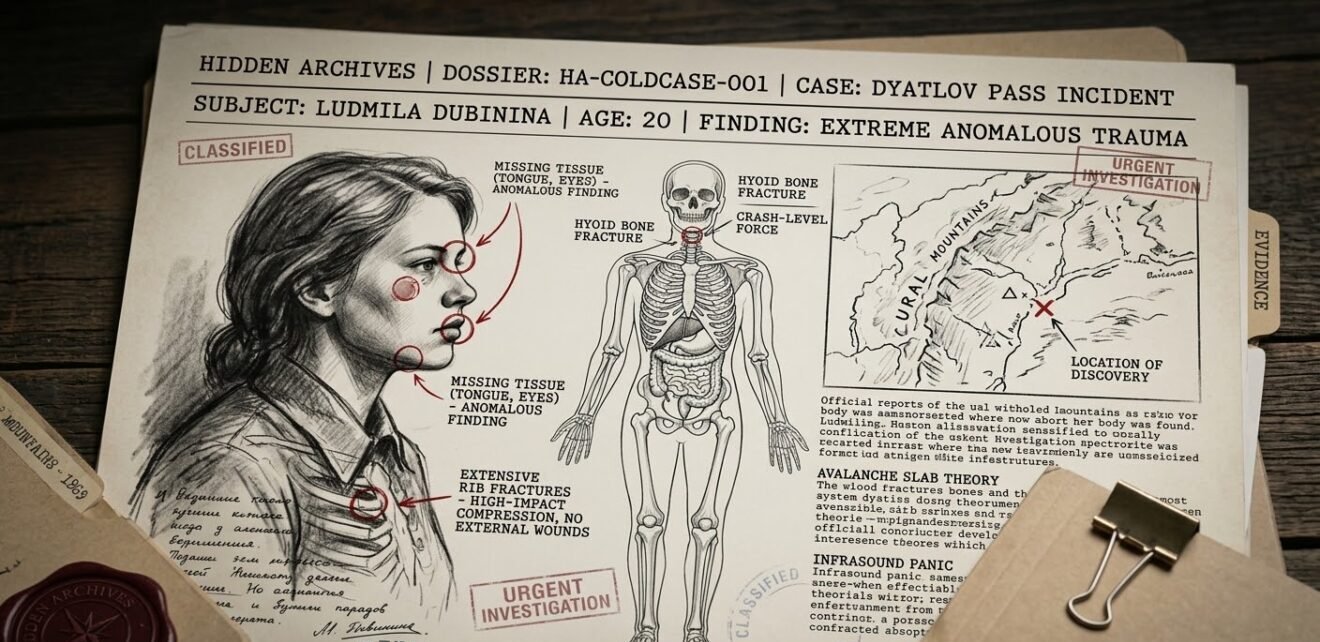
February 1959. The Ural Mountains, Soviet Union. Nine experienced hikers, led by Igor Dyatlov, set out on a journey into the frozen wilderness. They never returned. When rescuers finally found their campsite on the slopes of Kholat Syakhl—translated by the local Mansi people as the “Mountain of the Dead”—they discovered a scene that continues to haunt investigators and mystery enthusiasts six decades later.
Welcome to the Hidden Archives. Today, we reopen one of the most perplexing cold cases in modern history.
The Expedition: A Journey Into the Unknown
The group consisted of eight men and two women, most of them students or graduates from the Ural Polytechnic Institute. They were all Grade II hikers with ski tour experience. Their goal was to reach Mount Otorten, a route classified as “Category III” the most difficult at that time of year.
One member, Yuri Yudin, fell ill and turned back early—a twist of fate that made him the sole survivor of the group, though he never saw his friends alive again.
The Discovery: A Scene of Pure Terror
When the group failed to send a telegram by February 12th, a search party was dispatched. On February 26th, they found the tent. It was sliced open from the inside.
Even more disturbing were the footprints. Nine sets of tracks led away from the tent toward the woods, despite the temperature being nearly -30°C (-22°F). Some hikers were barefoot; others wore only a single sock or felt boots.
The Forensic Anomalies
As the bodies were recovered over the following months, the mystery deepened:
- Internal Trauma: Two victims had major skull damage, and two had extensive chest fractures. Experts compared the force required to cause such injuries to that of a high-speed car crash.
- Missing Features: One victim was missing her tongue and eyes.
- Radioactivity: Small amounts of radioactive contamination were found on the clothing of some victims.
- The Paradox: Despite the brutal internal injuries, there were no external soft tissue wounds or bruises.
Top Theories: From Science to Conspiracy
For years, the “Hidden Archives” of the Soviet government kept the case under wraps, leading to a vacuum filled by wild theories.
1. The Slab Avalanche (The Scientific Lead)
In 2021, a study published in Communications Earth & Environment suggested a “Slab Avalanche.” The theory posits that a heavy block of snow slid down onto the tent while the hikers slept, causing the internal injuries and forcing their panicked escape.
2. Infrasound and “The Hum”
Some researchers believe that the unique wind patterns over the Kholat Syakhl mountain could have created infrasound—low-frequency sound waves that cause intense feelings of dread, panic, and nausea in humans. This could explain why the hikers fled their tent in a state of sheer terror.
3. Military Testing and “Orange Orbs”
Witnesses in the area reported seeing “glowing orange orbs” in the sky on the night of the incident. This led many to believe the hikers stumbled upon a secret Soviet military test, perhaps a parachute mine or a vacuum bomb, explaining the radiation and internal trauma.
4. The “Menk” (The Yeti of the Urals)
Local folklore speaks of the Menk—a creature similar to Bigfoot. While skeptics dismiss this, the sheer brutality of the injuries and the isolated location keep the legend alive in the hearts of paranormal investigators.
The Final Dossier
Was it a freak act of nature, a tragic scientific anomaly, or a dark government secret? While the 2021 avalanche study provides a logical explanation, many questions remains—especially regarding the radioactive clothing and the missing tongue.
The Dyatlov Pass remains a silent witness to a night of absolute horror. Until new evidence emerges from the depths of history, it remains one of the greatest “Hidden Archives” of our time.